Collector's FAQ
Getting Started with Identification
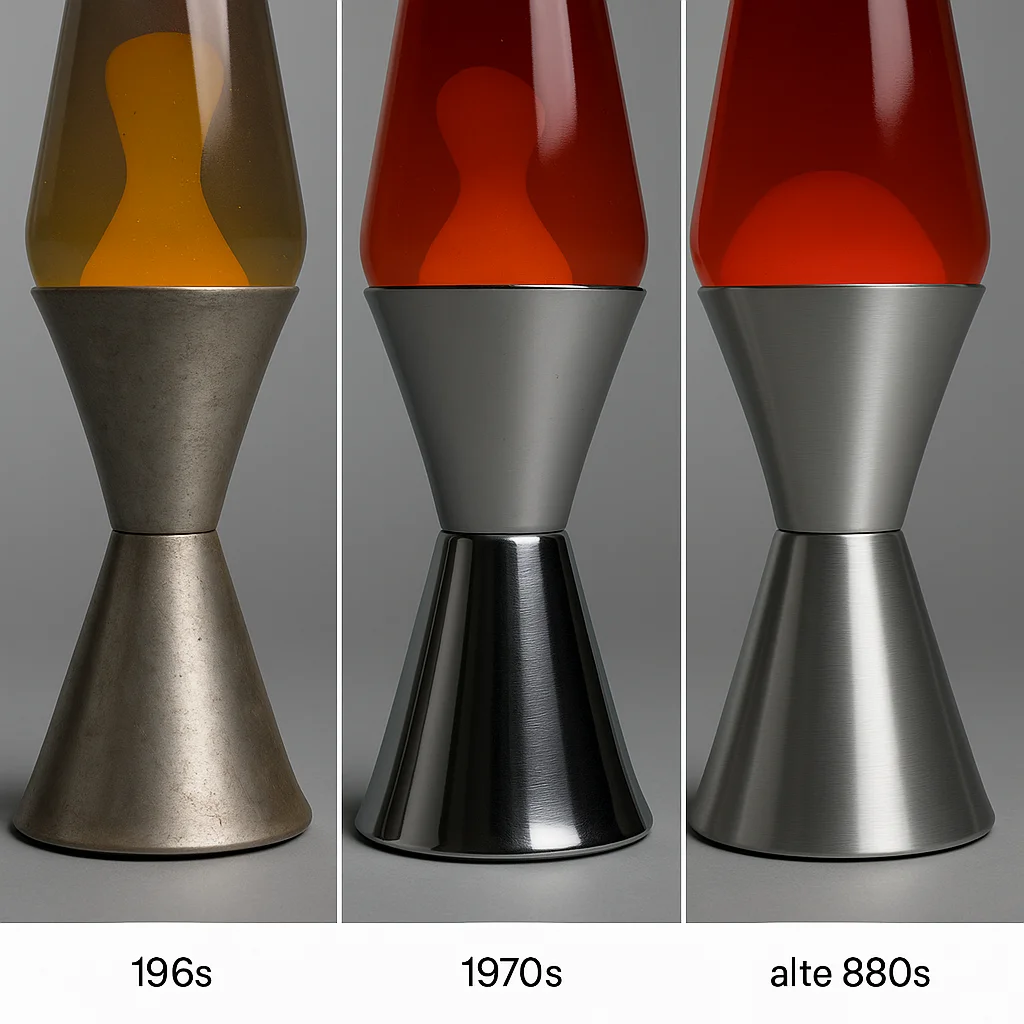
The first question most collectors ask — sometimes in a mild panic, standing over a car-boot find — is simply: what have I got? Mathmos lamps changed substantially across the decades, and a lamp from 1968 looks and behaves quite differently from one made in 1995, even if both carry broadly similar silhouettes. The Model Identification Guide covers the full taxonomy, but the quickest orienting details are the cap and base profile, the bottle glass colour and opacity, and any markings stamped or printed on the base itself. Early Crestworth-era lamps (the company operated under that name before becoming Mathmos in 1992) tend to have heavier, more industrial bases with a distinctly utilitarian feel — functional objects that hadn’t yet decided they were design icons. Later caps grew more refined, then more obviously fashionable, then occasionally a little regrettable.
Dating Your Lamp Accurately
Production dating is one of the more satisfying puzzles in this hobby, and also one of the more humbling ones. There is no single silver bullet. The Production Dating Reference brings together the best available evidence — base stamp formats, bottle glass batches, flex and plug styles for UK-market lamps, and the subtle shifts in coil wire gauge that changed at least twice across the lamp’s early production history. A collector who has handled fifty lamps develops a feel for these things that is genuinely difficult to articulate. The glass on a late-sixties bottle has a particular weight and slight irregularity; mass-production smoothed that out over time, which is either progress or a shame depending on your disposition.
One commonly asked question: does the colourway help with dating? Sometimes, yes. Certain combinations were produced only during identifiable windows, and a few limited runs were tied to specific retail partnerships or promotional moments. But colourway alone should never be treated as definitive — bottles were refilled, liquids replaced, and caps swapped at various points in a lamp’s life, which means the exterior can be misleading. Treat colour as supporting evidence, not primary.
Restoration: What to Do (and What to Leave Alone)
This is where collectors tend to disagree most vigorously. The prevailing view on this site — argued at length in Restoration Principles: Preserving Historical Integrity — is that intervention should be proportionate and reversible wherever possible. A lamp that flows beautifully does not need its liquid changed simply because changing liquid is something you know how to do. Conversely, a lamp with a cracked coil or clouded fluid that genuinely no longer functions is not being preserved by leaving it on a shelf; it is being slowly lost.
Common questions include: Can I re-wire an old lamp? Yes, and for safety reasons with any lamp showing deteriorating flex, you arguably should — though the work should respect period-appropriate fittings where those can be sourced. Should I polish the base? Only if you understand what you might be removing. Some patina is historically meaningful; some is just grime. The Era-by-Era Restoration Guidance breaks this down by period, because a 1960s base and a 1990s base are not equivalent objects and do not deserve identical treatment.
The single most frequent restoration mistake is impatience — adding heat, shaking the globe, or disassembling components before understanding what a lamp is supposed to do at rest and in motion.
A Note on Storage and Display
Keep lamps away from direct sunlight, which degrades both the wax compounds and the liquid over time. Store upright. If a lamp will be unlit for an extended period, some collectors place a small card cap over the globe to prevent dust settling on the glass in ways that prove surprisingly stubborn to clean. Temperature stability matters more than most people expect.
For broader context on why any of this effort is worthwhile, the Cultural Significance and Design Evolution by Era pages are good companions to the practical guidance here.