A Complete History of Mathmos and the Lava Lamp
The Inventor and His Unlikely Inspiration
The lava lamp begins, as so many enduring things do, with an eccentric Englishman and a problem that probably shouldn’t have needed solving. Edward Craven Walker — nudist, amateur filmmaker, entrepreneur — noticed a homemade egg-timer bubbling away behind the bar of a pub in Hampshire sometime in the 1940s. The device was little more than a cocktail shaker filled with translucent liquid and a blob of something that rose and fell with the heat of a candle beneath it. Most people would have ordered their drink and moved on. Craven Walker spent the next fifteen years figuring out how to turn the idea into a product.
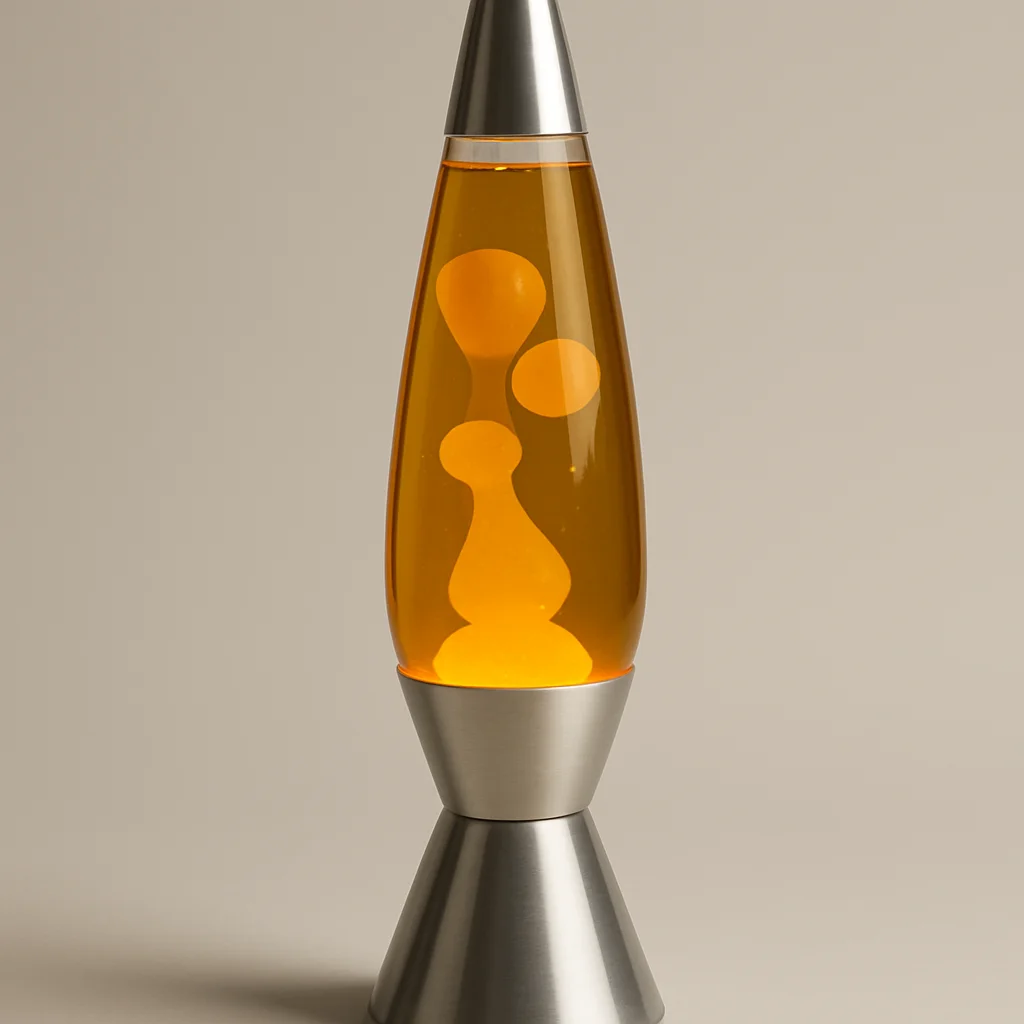
The result, launched in 1963, was the Astro lamp. Craven Walker’s company, Crestworth Ltd, based in Poole, Dorset, began producing what he grandly termed a “display lamp” — a tall, rocket-shaped glass vessel filled with a proprietary wax compound suspended in a water-and-solvent mixture, heated by a light bulb in an aluminium base. The science is deceptively simple: the wax and liquid are formulated to have nearly identical densities at room temperature, so a small amount of heat is enough to tip the wax into rising, the cooling at the top enough to bring it back down. The effect is almost biological — unhurried, rhythmic, impossible to look away from.
From Crestworth to Mathmos
Crestworth sold the Astro lamp steadily through the 1960s and into the 1970s, licensing the design internationally — most famously to Haggerty Enterprises in the United States, whose Lava Lite brand would make the lamp a fixture of American pop culture. The British originals, meanwhile, developed their own quiet following, their design evolving in small ways across the decades: base profiles shifted, cap shapes changed, colourways came and went with the fashions of their moment. The lamp was simultaneously very of its time and somehow outside it.
By the late 1980s, Crestworth’s fortunes had become somewhat fragile. Craven Walker eventually sold the company to David Mulley and Cressida Granger in 1989. They renamed it Mathmos — a word borrowed from the 1968 science-fiction film Barbarella, in which a subterranean lake of bubbling primordial energy supplies the planet Sogo with its life force. It was, you have to admit, a better name for a lava lamp company than Crestworth.
Under Mathmos, the lamp was repositioned — carefully, intelligently — as a design object rather than a novelty. The timing was fortunate. The 1990s brought a wave of renewed affection for 1960s and 1970s aesthetics that moved through interior design with roughly the same force as the original had moved through popular culture. The Astro lamp, barely changed in its essentials, suddenly felt prescient rather than retro. Sales recovered, new colourways appeared, and a generation of design-conscious buyers discovered the lamp for what it had always been: a genuinely original object.
Why the History Matters to Collectors
Understanding this timeline is not merely interesting — it is practically useful. The differences between a mid-1960s Crestworth lamp, a late-1970s example, and a 1990s Mathmos production run are visible in the base casting, the glass profile, the cap design, and the colourway choices available in each period. These details are the collector’s vocabulary. A lamp misidentified as earlier than it is may be restored with inappropriate materials or sold at an inaccurate valuation; a lamp correctly dated can be assessed, preserved, and appreciated on its own terms.
The pages on model identification and production dating go deeper into the specific physical markers that distinguish one era from another. For those who want to understand the broader arc of how the design changed over forty years, the design evolution by era section traces each generation in detail — because, as Craven Walker himself might have noted, the details are rather the point.