Restoration Principles: Preserving Historical Integrity
The Lamp Before the Wrench
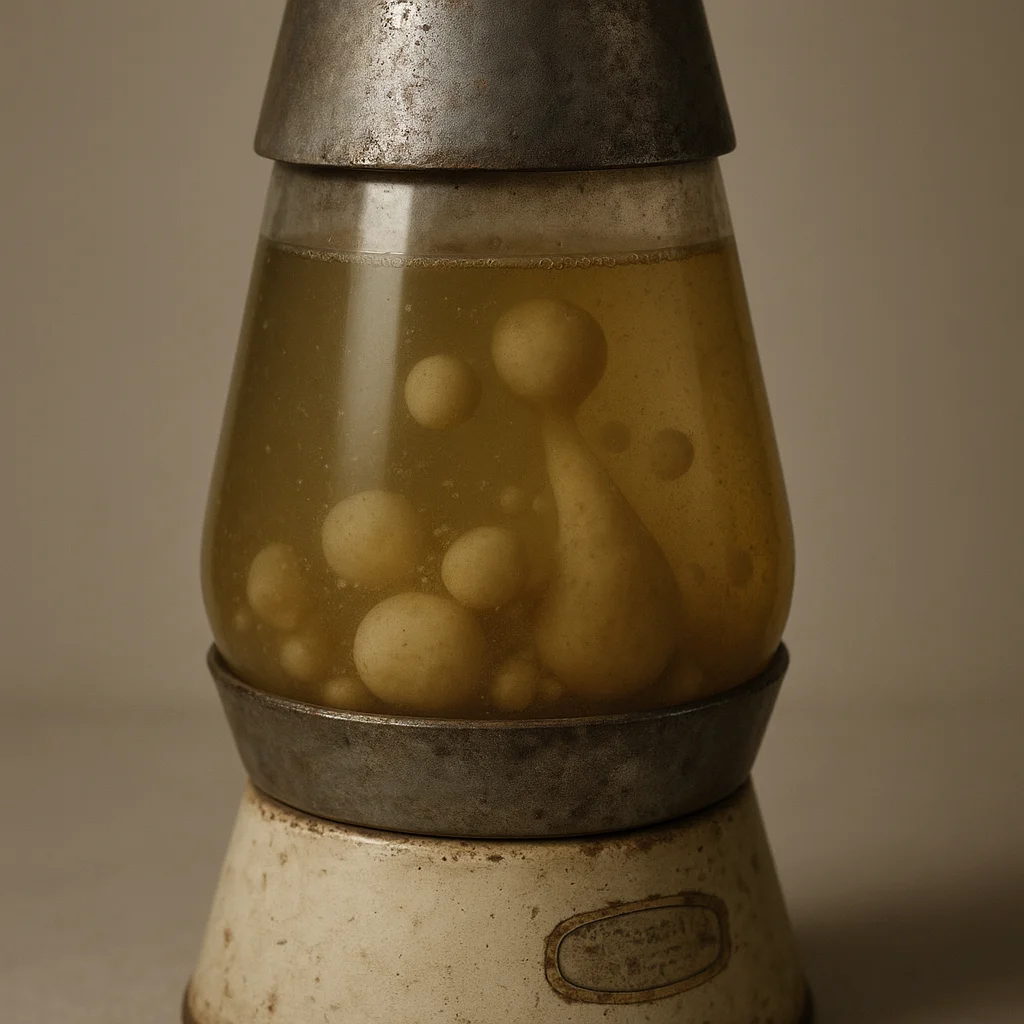
There is a particular kind of damage that looks like care. A well-intentioned collector, armed with enthusiasm and a bottle of distilled water, can do more lasting harm to a 1970s Mathmos Astro than years of benign neglect on a dusty shelf. This is not a warning designed to frighten — it is an invitation to slow down. Every lamp that arrives in a collector’s hands carries information: in the cloudiness of its fluid, the patina of its cap, the particular amber-yellow of an ageing translucent column. That information is worth reading before it is erased.
The founding principle here is simple, even if the practice is not: understand the lamp first. Before any restoration begins, spend time with the Model Identification Guide and the Production Dating Reference to establish what you actually have. A lamp misidentified as a later replacement unit might, in fact, be a first-run production piece whose clouded wax and original fluid represent exactly the condition it should be in. Touching it differently once you know that.
Reversibility as a Guiding Principle
Good restoration practice borrows from museum conservation a concept that the lampcraft world rarely discusses explicitly: reversibility. Any intervention made to a lamp should, ideally, be one that a future owner or conservator could undo without further loss. This rules out quite a lot.
Repainting a base in a non-original colour is irreversible. Replacing a period-correct coil with a modern reproduction coil is reversible in theory, but the original coil — if it survives — is itself an artefact with weight and provenance. Polishing away the oxidation on a chromed brass cap removes surface evidence of the lamp’s age and use-history. The chrome underneath may gleam, but something genuinely historical has been lost in the process, and no amount of gleaming replaces it.
The more useful question to ask of any proposed intervention is not will this make the lamp look better? but will this make the lamp less itself? A 1968 Astro that has aged honestly is more interesting than a 1968 Astro that has been restored to a condition it never quite had — a kind of hyper-new appearance that reads, to any knowledgeable eye, as fabricated. Mid-century furniture collectors understand this instinctively; a Eames chair with original fabric, even worn, commands a different kind of respect than one reupholstered in period-adjacent vinyl.
What Restoration Is Actually For
None of this means a lamp should simply be left to deteriorate. Restoration has a legitimate and valuable purpose: it keeps working lamps working, and it prevents further degradation where degradation is genuinely harmful rather than merely cosmetic. A seized brass cap that cannot be opened without damage to the column may need careful intervention before the wax can ever flow again. Electrical components from the 1960s may require replacing on safety grounds, and that replacement is both justified and, done properly, documentable.
The distinction that matters is between functional restoration and cosmetic restoration. Functional restoration — fluid replacement where the original has failed beyond recovery, electrical safety work, coil re-seating — preserves the lamp’s ability to be itself. Cosmetic restoration, when driven by a desire to make the lamp look newer rather than to arrest genuine damage, tends to work against historical integrity more than it serves it.
The Era-by-Era Restoration Guidance pages approach each production period with this distinction in mind, offering specific advice calibrated to what each era’s lamps actually need — and what they are better left to keep.
A Note on Documentation
Whatever choices are made, record them. A simple note tucked inside the base, or kept with the lamp, noting what was done, when, and with what materials, adds rather than subtracts from a lamp’s history. Future collectors will be grateful. So, quietly, will the lamp.
For broader context on why these artefacts deserve this level of consideration, the Cultural Significance page sets out what the lava lamp has meant — and still means — beyond its modest silhouette.