Production Dating Reference
Why Dating Matters Before You Do Anything Else
A lava lamp is not just a lava lamp. The one sitting on your workbench might be a first-run Astro from 1966, or it might be a mid-1990s reissue wearing very similar clothes. The difference matters enormously — not just to value, but to any restoration decision you make. Fit the wrong cap style, use a reproduction label, or swap in a base from a different production run, and you’ve quietly erased something that can’t be unwritten. Dating your lamp accurately is, in that sense, an act of respect.
Mathmos (trading as Crestworth through most of the 1960s and into the early 1970s) left a surprisingly readable paper trail if you know where to look. Labels, batch codes, hardware profiles, and even the specific shade of a metal finish can place a lamp within a reasonably narrow window of production. None of these methods is infallible in isolation, but used together they build a convincing picture.
Reading Labels and Batch Codes
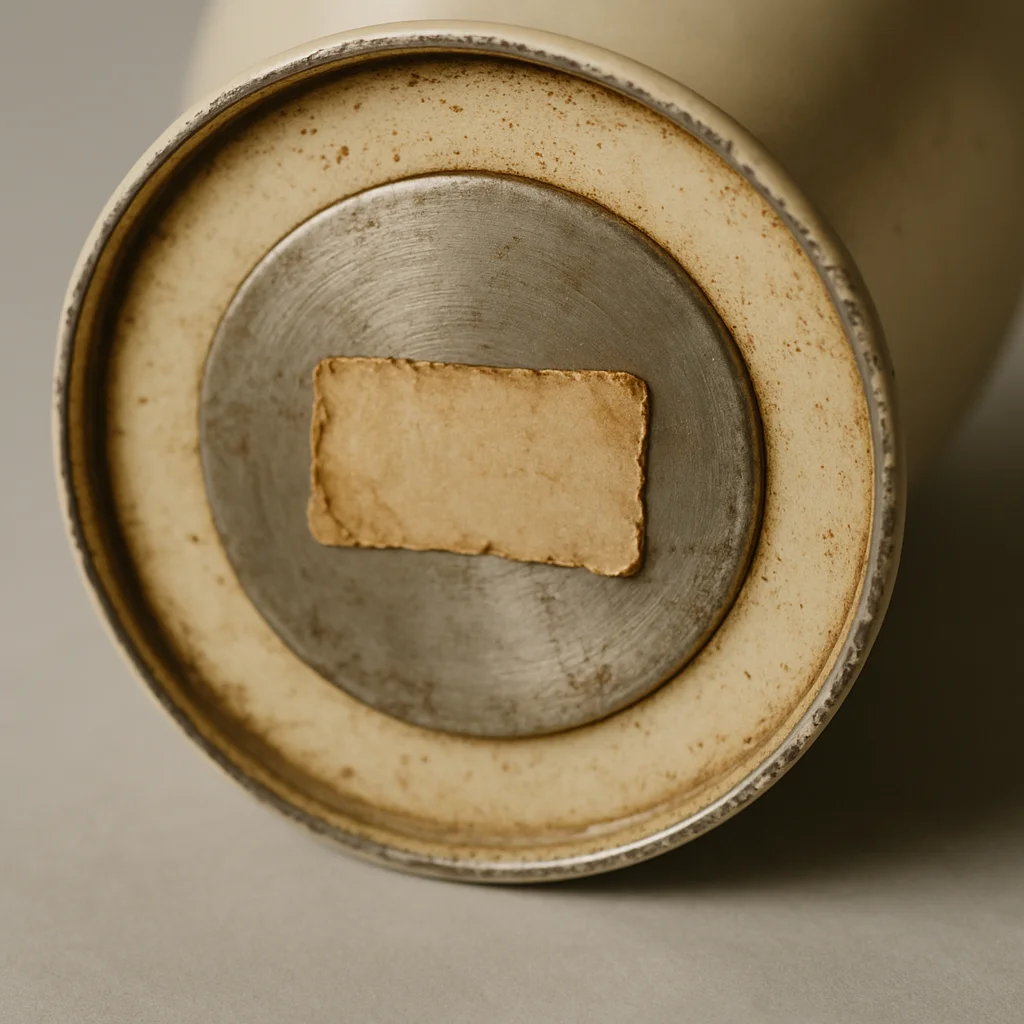
The underside label is usually the first place to look, and on lamps from the late 1960s through the 1980s it is often the most informative. Early Crestworth labels used a particular typeface — a slightly condensed, no-nonsense sans-serif — that was replaced progressively through the 1970s by more rounded letterforms. The wording itself changed too: voltage and wattage declarations, patent numbers, and country-of-origin text all shifted at datable points in the production history.
Batch codes, where present, typically appear as a short alphanumeric string stamped or printed near the label edge. Mathmos used several coding systems across different eras, and while the company’s own archival records are not publicly comprehensive, the collector community has cross-referenced enough surviving examples to establish reliable patterns. The Model Identification Guide on this site documents the known label formats by model and approximate period, which makes it a useful companion to the dating work described here.
Hardware as a Dating Tool
Caps, bases, and the profile of the bottle itself all changed in ways that correlate with production periods. The early Astro caps, for instance, had a particular weight and thread pitch that was subtly revised by the early 1970s — something you feel as much as see when you handle enough of them. Base finishes moved through distinct phases: the almost-warm brass tones of the late 1960s giving way to cooler chrome expressions in the mid-1970s, then to matte and brushed finishes as the 1980s arrived (a trajectory that rhymes, interestingly, with what was happening in hi-fi and kitchen hardware at exactly the same time).
Bottle glass is another underappreciated indicator. Thickness, seam position, and the subtle greenish cast of older glass all vary between runs. This is slower, more intuitive knowledge that develops with handling rather than reading, but it is genuine knowledge nonetheless.
Cross-Referencing Against Known Records
No single detail clinches a date on its own. The most reliable approach is triangulation: label style, hardware profile, bottle characteristics, and any accompanying documentation (original boxes, receipts, and magazine advertisements have all been used to anchor dates) assessed together. Patent numbers are particularly useful anchors — their registration dates establish a no earlier than boundary that label evidence can then refine.
Putting It All Together
Production dating is patient work, but it rewards patience generously. Once you know where a lamp sits in the chronology, every subsequent decision — cleaning method, replacement fluid, whether to touch the cap at all — becomes clearer and more defensible. The Design Evolution by Era page gives useful context for understanding why certain features appeared when they did, and the Restoration Principles guidance builds directly on the kind of accurate dating this page describes. Get the date right, and the rest follows more naturally than you might expect.