Cultural Significance of the Lava Lamp
Born in the Optimism of the Sixties
There is something almost too perfect about the fact that the lava lamp arrived in 1963. The decade was just finding its stride — the old certainties loosening, colour creeping back into a world that had spent years in grey — and here was an object that refused to hold still. Edward Craven Walker’s Astro lamp, manufactured under the Crestworth name and later carried forward by Mathmos, was not merely a novelty. It was, in its slow-bubbling way, a small manifesto: that beauty could be purposeless, that light could be meditative, that your living room deserved something stranger and more alive than a table lamp with a pleated shade.
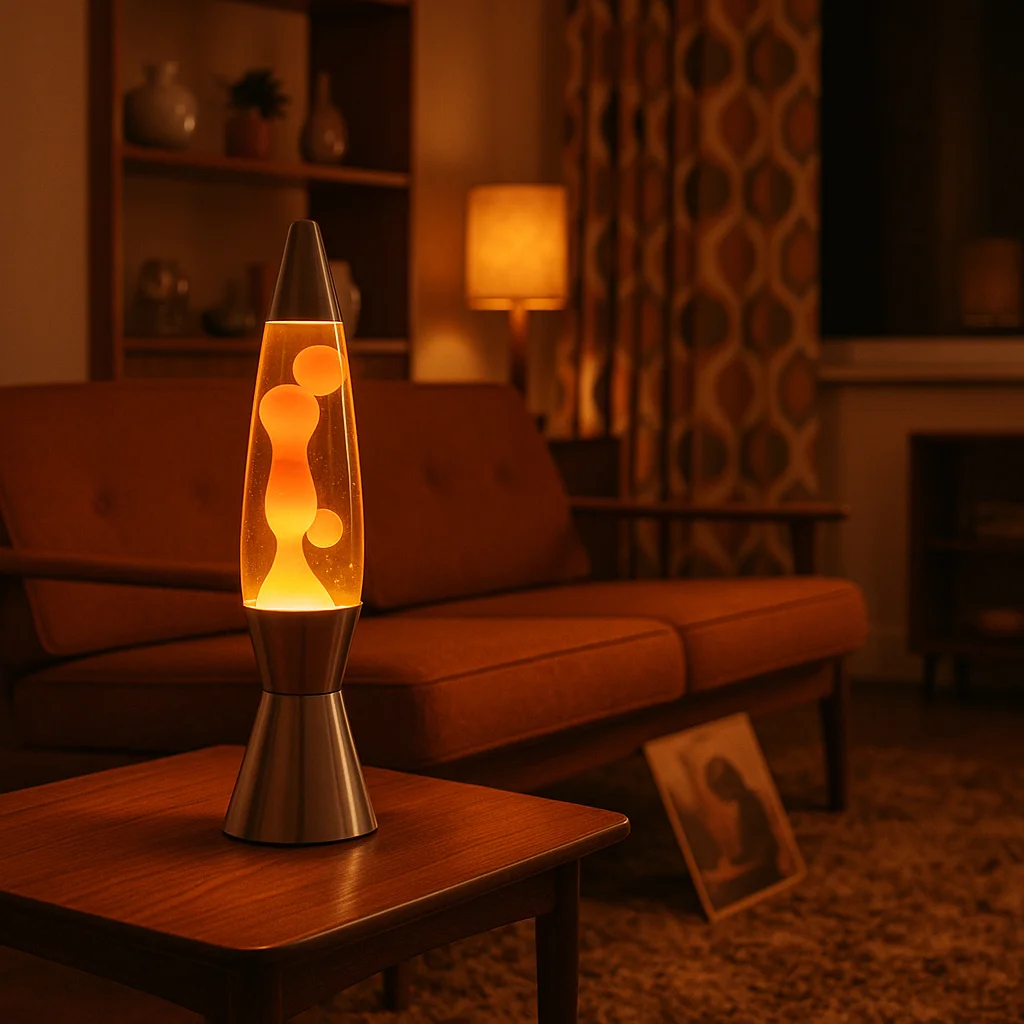
The counterculture adopted it almost immediately, and not by accident. The lava lamp asked you to sit and watch, which ran entirely counter to the period’s frantic productivity. Psychedelia found in it a ready-made visual analogue — those rising and falling blobs rhyming, without any chemical assistance, with the kind of perceptual loosening that the era was otherwise pursuing by other means. By the late 1960s it had become a fixture of student flats, underground venues, and the kind of progressive living rooms where you might also find an Eames chair and a copy of I Ching. It belonged, in other words, to exactly the world it seemed to have been designed for.
The Long Middle: Kitsch, Then Reclamation
The Seventies were less kind. As the counterculture calcified into lifestyle, the lava lamp drifted toward novelty-shop territory — the kind of thing given as a joke gift, slightly embarrassed about its own existence. This is the period that haunts collectors: lamps from this era are sometimes in excellent condition precisely because nobody took them seriously enough to use them heavily, which is a particular kind of irony.
The Nineties revival was a different proposition entirely. What happened was less a rediscovery than a recontextualisation: the decade’s appetite for retro-futurism, its fondness for op-art geometries and space-age optimism, found in the lava lamp a perfectly preserved specimen of an earlier visual culture. Mathmos — who had acquired the brand and relaunched it with considerable energy — understood that they were selling not merely a product but a piece of inherited strangement. The lamp reappeared in music videos, in television set dressing, in the bedrooms of teenagers who had been born a decade after the original moment and felt, somehow, that they had missed something worth mourning. (They were not wrong, though the lamp was back, which helped.)
What It Meant, and What It Still Means
To understand the lava lamp as a design object rather than a punchline is to understand something about the broader history of mid-century optimism. It sits, philosophically, near the Bubble Chair and the Ball Chair — furniture that imagined the future as rounded, organic, gently absurd. Where the Modernists had wanted clean lines and rational purpose, these objects wanted wonder. The lava lamp is, in this reading, less a lighting fixture than a kinetic sculpture sold at an accessible price point — which is rather a good trick, and Craven Walker knew he was pulling it.
Its cultural staying power rests on this tension between accessibility and genuine strangeness. It was never quite respectable enough to be institutionalised, and never quite frivolous enough to be forgotten.
The lava lamp’s journey from avant-garde curio to cultural shorthand to collector’s artefact mirrors the wider arc of Sixties design more broadly. For those interested in how specific models fit into this story, the Design Evolution by Era and Model Identification Guide pages trace the object’s changing form in useful detail — because understanding what a lamp meant, historically, is inseparable from understanding what it looked like when it meant it.