Design Evolution by Era
The 1960s: When the Object Was the Idea
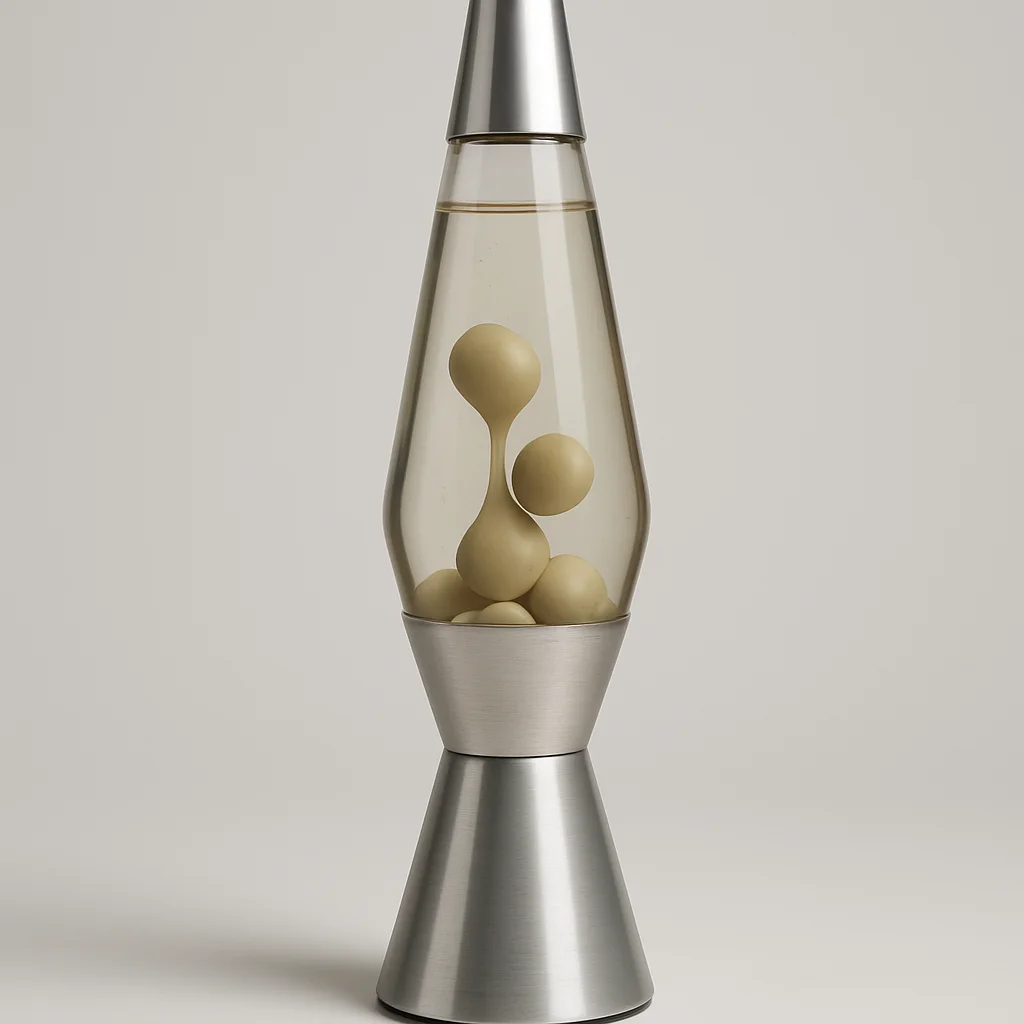
Edward Craven Walker’s original Astro lamp arrived in 1963 carrying the full weight of its era’s optimism — rounded, unapologetically sculptural, and built from materials that felt genuinely novel at the time. The early globe was pyrex-clear, the base and cap machined from aluminium with a satisfying solidity that later decades would quietly abandon. Proportions mattered enormously to Craven Walker, and the original Astro’s silhouette — narrow foot, swelling middle, tapered top — was as considered as anything coming out of a Scandinavian furniture studio at the time. (The analogy to a rocket is obvious and frequently made; the analogy to a particularly elegant thermos flask is less often noted, but equally apt.)
Colourways in this founding decade tended toward the theatrical: blue liquid with white wax, red with yellow, that particular amber-and-orange combination that photographs so warmly it looks almost edible. The lamps were lit by incandescent bulbs of specific wattage, and that heat source was never incidental — it was the mechanism, the drama, and the constraint around which every design decision bent.
The 1970s: Wider, Wilder, and Occasionally Regrettable
The 1970s brought a loosening of standards that mirrored broader cultural shifts rather neatly. Base profiles became wider and squatter on some models; colourways multiplied in ways that ranged from the genuinely beautiful to the quietly unfortunate. This was also the decade when Crestworth — the original manufacturing company — began transitioning toward what would eventually become Mathmos, and a collector studying base stampings and cap finishes from this period will notice inconsistencies that reflect a business in productive flux. The production dating reference covers these transitional markers in some detail.
Materials began to diversify. Some bases moved away from machined aluminium toward cast variants with slightly different surface textures, and the glass globes on certain runs show subtle dimensional variation that makes them identifiable to an experienced eye. None of this diminished the lamp’s essential character — the wax still rose, the liquid still turned — but it makes period identification considerably more interesting.
The 1980s and Early 1990s: Consolidation and the Mathmos Rename
By the time Mathmos formally took the name in 1992, the design had undergone a quiet consolidation. The core Astro remained recognisable from its 1963 origins, which is either a tribute to Craven Walker’s original vision or a reflection of cautious commercial instinct — probably both. What changed was the surrounding ecology: new shapes began appearing alongside the classic, base materials continued to evolve, and quality control became more consistent as manufacturing processes matured.
This era is particularly important for collectors attempting to establish a lamp’s exact origins, because surface similarities can mask meaningful differences in construction. The model identification guide unpacks these distinctions methodically, with attention to the details — coil spring configuration, cap thread depth, base casting marks — that separate a late-1980s example from an early-1990s one.
Into the Late 1990s and Early 2000s: New Materials, New Thinking
The late 1990s brought renewed design ambition. New shapes entered the range alongside the enduring Astro, and materials began to reflect broader industrial design trends — translucent and frosted plastics appeared, proportions shifted, and a younger design sensibility became visible in some of the newer models. Whether these departures hold up as well as the original form is a question the design history explores with appropriate scepticism.
Understanding how a lamp’s design evolved over four decades is the essential first step before any restoration work begins. A choice that suits a 1990s example might actively diminish a 1960s original. The restoration principles page and the era-by-era restoration guidance carry these distinctions forward into practical guidance.